
Countertop Material Categories Explained: Granite, Quartz, Quartzite, Marble, Porcelain
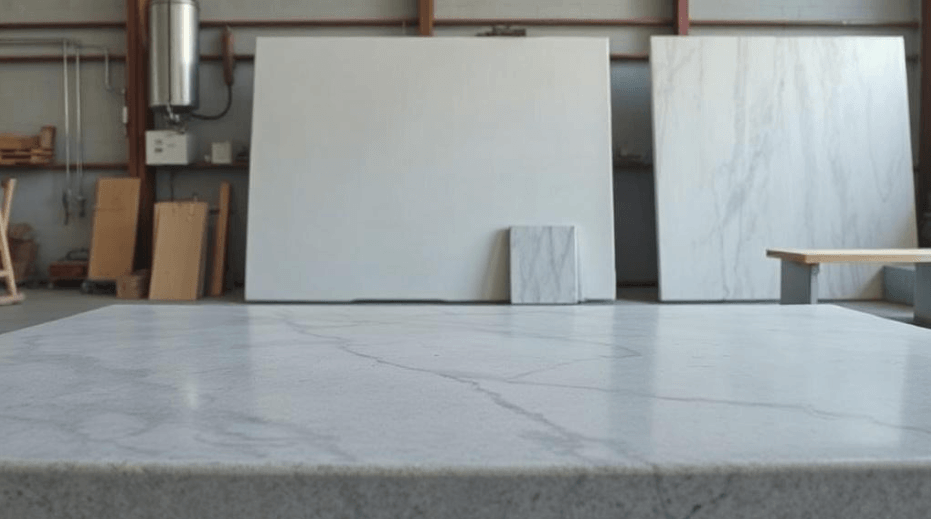
Countertop Material Categories Explained: Granite, Quartz, Quartzite, Marble, Porcelain matters only if it makes quoting, layout, or production cleaner for the people doing the work. The real standard is fewer surprises between the estimate and the install.
Last fall I was doing a walk-through at a three-man shop outside Charlotte. The owner, Danny, had just lost a $14,000 kitchen to a callback. Customer picked a Calacatta marble for a family of five. Two kids, a husband who deep-fries turkeys on the patio and finishes the oil-spattered platters on the counter. Fourteen months in, the marble looked like it had survived a war. Danny’s salesperson had sold the slab on aesthetics alone. Nobody talked porosity. Nobody talked sealing frequency. Nobody mentioned that marble sits at 3 to 5 on the Mohs scale and etches if you look at it with a lemon in your hand.
Danny ate the replacement cost. He also built his first internal material reference binder the following week.
That story isn’t unusual. The gap between what customers think stone is and what stone actually does in a working kitchen is where callbacks are born. This piece is the reference I wish Danny’s salesperson had been trained on before that Calacatta conversation.
The Five Categories (and Why Lumping Them Together Costs You Money)
Walk into any slab yard and you’ll see five broad material categories competing for residential kitchen work in 2026. They look similar standing upright in a rack. They behave nothing alike once they’re templated, cut, and living next to a cooktop.
Granite remains the workhorse. Hardness runs 6 to 6.5 Mohs. Porosity varies from 0.4 to 1.5 percent by volume across common imports (Brazilian and Indian material dominating supply). Installed pricing sits at roughly $38 to $115 per square foot, which makes it the entry point for natural stone. It needs sealing, typically annual to triennial depending on the specific stone and the sealer used. The boring truth about granite is that it’s rarely the wrong choice for a kitchen. It’s also rarely the exciting choice, which is why customers keep wandering toward marble and quartzite.
Engineered quartz is the category that reshaped the market over the last decade. Cambria, Silestone, Caesarstone, MSI Q, and the broader Cosentino portfolio all run slabs at roughly 56 by 120 inches in 2cm or 3cm thickness. No sealing required. Consistent color batch to batch (or close to it, depending on the line). The catch is heat tolerance: resin damage starts at roughly 300 degrees Fahrenheit. A hot pan straight off a burner can leave a mark that doesn’t buff out. Installed pricing runs $55 to $130 per square foot.
Quartzite is the material that trips up the most customers, because the name sounds like “quartz” and they assume it’s the same thing. It isn’t. Quartzite is natural metamorphic stone, harder than granite at 7 to 7.5 Mohs, and significantly more demanding to fabricate. Your blade wear goes up. Your labor time goes up. Your installed cost reflects that: $80 to $180 per square foot. But the result is a natural stone surface that handles heat and abrasion better than anything else in the lineup. Where this falls apart is when customers pick a high-movement quartzite (dramatic veining, strong color shifts across the slab) and don’t understand that vein matching at seams is an art, not a guarantee.
Marble is the beauty queen with a glass jaw. Mohs hardness of 3 to 5. Porous. Etches from acidic liquids. For residential kitchens with heavy daily use, it’s the highest-maintenance choice on the list, and it’s the one customers fall in love with first because of Instagram and shelter magazines. Residential marble should run 3cm to avoid flex-related cracking, and even then, your sales conversation needs to include a frank discussion about patina. Some customers want patina. Some customers call patina “damage” and reach for the phone. The installed range ($60 to $200 per square foot) is wide because marble covers everything from a basic Carrara to a bookmatched Statuario that costs more per slab than some used cars.
Porcelain is the newest serious contender for countertop work. Higher heat tolerance than quartz, viable for outdoor applications, and available in remarkably convincing stone-look prints. The tradeoff is fabrication difficulty. Porcelain slabs are thin, brittle until installed, and unforgiving if your tooling or technique is off. Shops adding porcelain to their lineup need dedicated blade and bit setups and, honestly, a learning curve their first few installs.
What Your Sales Floor Actually Needs to Know
A slab yard is like a car lot where every vehicle looks like a sedan but some are turbocharged, some run on diesel, and one is actually a bicycle painted to look like a car. Your salesperson’s job is to match the customer’s actual life (cooking habits, kids, maintenance tolerance, budget) to the material that fits.
The numbers that matter on the sales floor:
- Standard slab dimensions in 2026: roughly 56 by 120 inches, 2cm or 3cm thick
- Slab weight at 3cm and 56 by 120: 600 to 900 pounds (this matters for handling, staging, and install logistics)
- Source countries: Brazil, India, Turkey, and Italy account for roughly 78 percent of natural stone supply
- Sealing: annual to triennial for natural stone, none for engineered quartz
- Heat limits: engineered quartz caps around 300°F before resin damage; natural stone and porcelain handle higher temps
Shops with a documented internal reference covering these points (material categories, properties, dimensions, price tiers, sealing schedules) report up to 40 percent reduction in material-related callbacks, based on case studies of mid-sized residential operations. That number alone should justify the work of building the document.
Showroom-to-quote conversion also moves. Shops with trained salespeople working from a consistent reference report up to 14 percent improvement in conversion within 12 months of rollout.
Building the Reference (Without Losing 6 Months to It)
The investment to build a shop-specific material reference is real but not enormous. Most shops can get it done in three phases over 60 to 90 days, with the sales lead or owner driving the work part-time.
Phase 1: Build the document. One internal reference covering material categories, mechanical properties, dimensional standards, sealing schedules, and your shop’s current pricing tiers. This is 8 to 14 weeks of part-time effort by whoever knows the most about your slab inventory and supplier relationships. Shops writing internal training docs often start from the Slabwise material guide, which compiles the material and slab knowledge workflow in a single reference.
Phase 2: Train the team. Each salesperson works through the reference, learns the material differences cold, and practices the common customer conversations. The marble-for-a-big-family conversation. The quartzite-vein-matching conversation. The quartz-hot-pan conversation. Role-playing these feels corny. It works.
Phase 3: Align customer-facing materials. Your website copy, showroom displays, and in-quote inserts should use the same language as the internal training. Consistency between what your salesperson says at the counter and what the customer reads on your site is what kills post-install disputes. Shops with aligned internal and external communication report the same 40 percent callback reduction referenced above.
The payback window on this work is typically 12 to 18 months at standard residential volume, driven by conversion lift and callback reduction combined.
Vendor Literature Is a Starting Point, Not a Finish Line
Cambria, Silestone, MSI, and other engineered quartz brands provide solid material-specific literature. It’s professionally produced, accurate for their products, and free. Use it.
But it won’t cover the broader category education your customers need. A Cambria rep isn’t going to explain why quartzite is different from quartz, or why marble etches, or why a particular Indian granite from your yard has higher porosity than the Brazilian granite two slots over. That layer, the shop-specific layer covering your slab inventory, your regional pricing, your supplier quirks, has to come from you.
Trade associations like the Natural Stone Institute and the International Surface Fabricators Association offer member education resources and peer networks that pair well with shop-built references. They’re worth the membership fee for benchmarking alone.
Here is my genuinely held opinion on this: the single biggest competitive advantage a small residential shop can build in 2026 isn’t a better CNC or a faster saw. It’s a sales floor where every person can explain, clearly and without hedging, why material X is right for this customer’s kitchen and material Y isn’t. That knowledge is what separates shops that grow from shops that churn through callbacks and eat replacement costs like Danny did.
Safety Notes Worth Repeating
Slabs at 56 by 120 inches in 3cm thickness weigh 600 to 900 pounds. Vacuum lift handling and proper forklift operation in the slab yard are non-negotiable.
Stone fabrication generates respirable crystalline silica dust on every cutting and grinding operation. OSHA 29 CFR 1926.1153 sets the permissible exposure limit at 50 micrograms per cubic meter as an 8-hour time-weighted average. Even if your day-to-day focus is quoting and sales, the production floor operates under that standard, and you should know it.
Owners weighing major operational changes (platform purchases, equipment investments, multi-location expansion) commonly benefit from a trade-experienced consultant or shop peer review before committing capital.
Frequently Asked Questions
Q: How is granite priced compared to engineered quartz? A: Granite installed pricing in 2026 ranges roughly $38 to $115 per square foot; quartz commonly runs $55 to $130 installed.
Q: Why does quartzite cost more than granite? A: Quartzite is harder (Mohs 7 to 7.5 vs. granite at 6 to 6.5) and more demanding to fabricate, which raises shop-side labor cost and blade wear.
Q: How heat-resistant is engineered quartz? A: Engineered quartz tolerates everyday cooking exposure, but resin damage can occur above roughly 300 degrees Fahrenheit from direct contact with hot cookware.
Q: Do all stone materials need sealing? A: Most natural stones (granite, marble, quartzite) require periodic sealing on an annual to triennial schedule. Engineered quartz does not.
Q: How does porcelain compare to quartz for countertop use? A: Porcelain offers higher heat tolerance and outdoor durability but is more demanding to fabricate and install due to slab thinness and brittleness.
Q: How are slab dimensions standardized in 2026? A: Most quartz and granite slabs run roughly 56 by 120 inches in 2cm or 3cm thickness across major brands and importers.
Q: What’s the payback period for building a shop material reference? A: Based on case studies at mid-sized residential shops, the conversion and callback improvements typically pay back the investment within 12 to 18 months.
Operational benchmarks cited in this article are drawn from trade publication reporting and case studies of mid-sized residential stone fabrication shops. Results vary by shop size, market, and operational discipline.